
Game Patents: Fun Is Designed, but Implementation Is an Invention
Looking through game-development content reveals an interesting phenomenon.
People are interested not only in a game's characters and story, but also in the judgment algorithms, rendering techniques, network compensation technologies, and mathematical processing methods operating behind them.
These technologies can go beyond development know-how and become patentable inventions.
However, statements such as “our game has great controls,” “we provide player-friendly hit detection,” or “we generate fun maps” are not enough to obtain a patent. The ideas that create the fun must be translated into a specific process performed by a computer.
Protect the technology that implements the rules, not merely the game rules
Abstract ideas such as win conditions or reward rules have limits when it comes to patent protection.
The situation changes when a technical processing structure is specified, including:
- what data is received as input;
- how the game state is determined;
- what formula or algorithm is applied;
- how the character, camera, screen, or server state is controlled according to the determination; and
- how latency, computation, memory use, or control error is reduced compared with existing approaches.
Korean patent law defines an invention as a highly advanced creation of technical ideas utilizing the laws of nature. Under the Korean Intellectual Property Office's examination standards for computer-related inventions, software information processing that is concretely implemented through hardware may be protected as a method, system, recording medium, or computer program stored on a medium.
The core of a game patent is therefore translating gameplay fun into a technical chain of cause and effect.
1. Controls and judgment technology
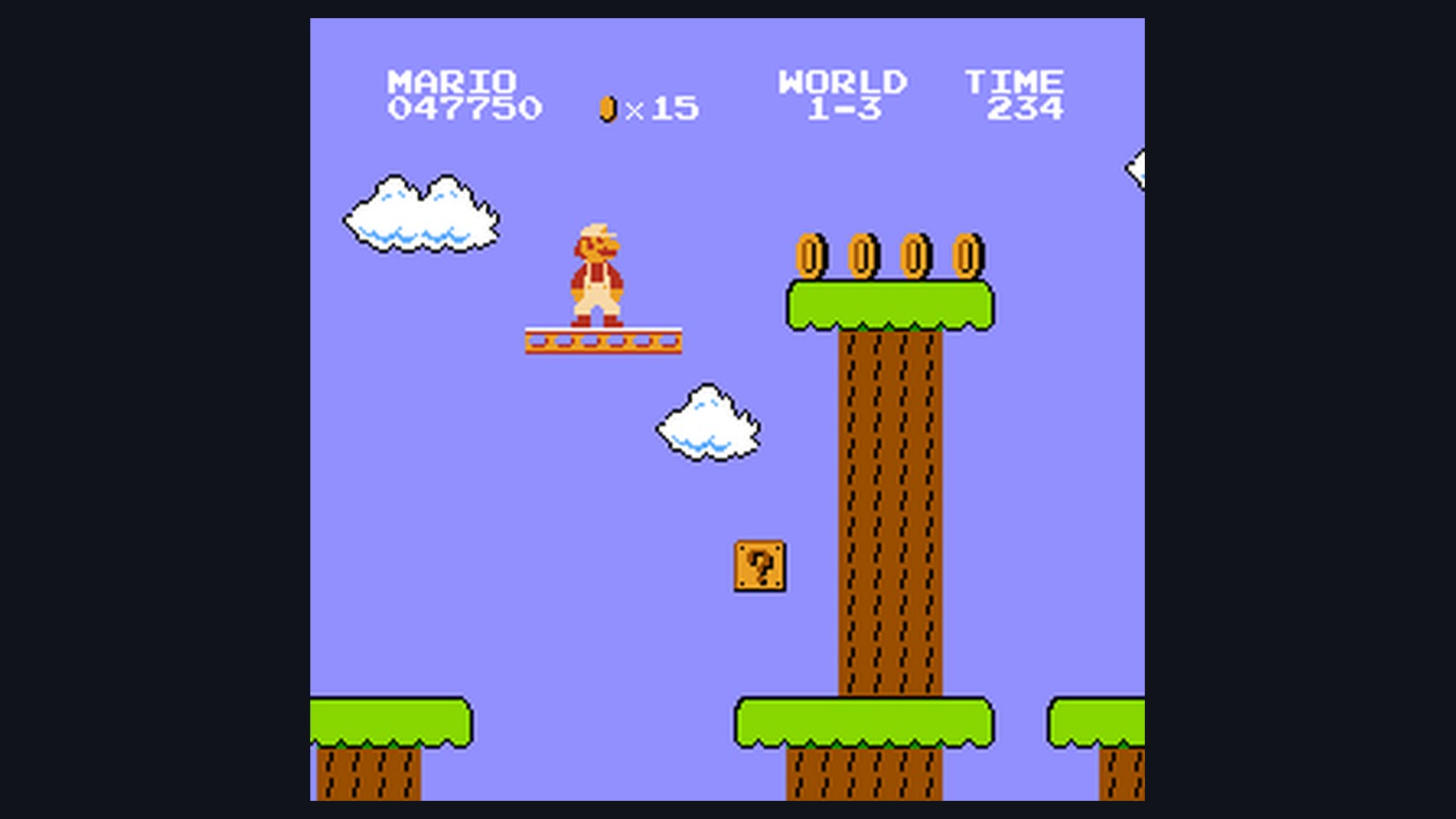
One field in which game developers invest substantial time and money is control feel.
A representative example is coyote time. Even after a character has left a platform, a jump is executed if the player presses the jump button within a short period. Jump buffering stores a jump command entered immediately before landing and executes it as soon as the character lands.
It is not enough to describe this simply as “a way to make jumping easier.” A patent specification can frame it as follows:
- Detect the contact state between the character and the terrain.
- Calculate the time elapsed since the state changed to non-contact.
- Determine whether a jump input was received within a preset grace period.
- Determine whether to permit the jump based on the character's velocity, the terrain slope, or the previous contact state.
- If the jump is permitted, change the velocity vector applied to the character.
The same applies to “edge-jump position correction” in platform games. When a character collides with the edge of a platform, the system can analyze collision depth and movement direction and automatically correct the character's position instead of blocking movement.
“Player-friendly hit detection” is also excellent patent material. One can devise a method that uses the attacker's aiming position, the target's movement speed, network latency, attack direction, and recent-frame position data to set the collision region used for judgment differently from the actual collision region.
Control feel may appear subjective, but it is implemented through time windows, input buffers, collision regions, velocity vectors, and state transitions. The more clearly these values and conditions are defined, the stronger the patent prospects become.
2. FPS and network technology
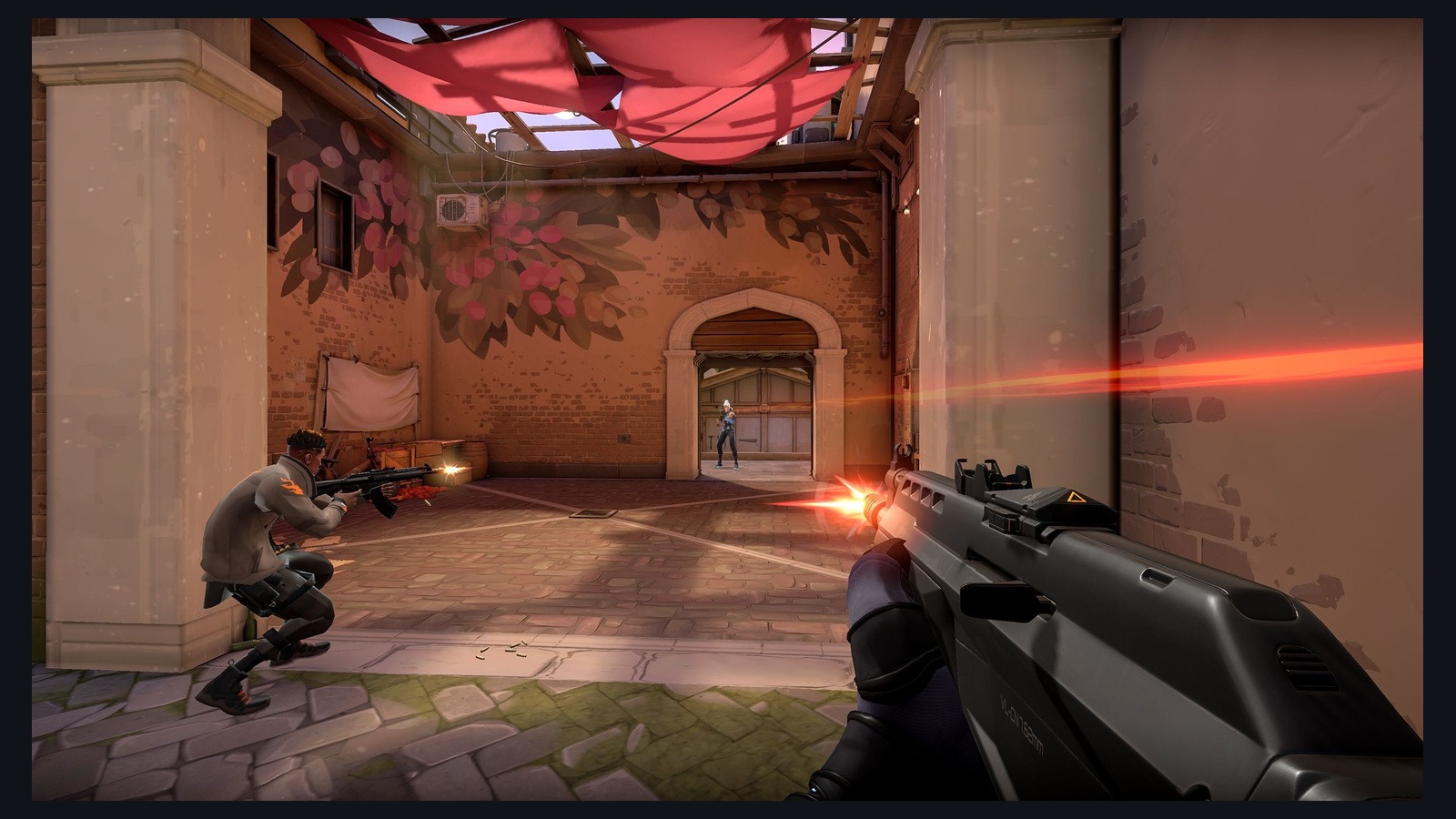
In an online game, the time shown on the player's screen and the server's time are not perfectly synchronized.
Even if the player accurately aims at and fires upon an opponent on screen, the opponent may already have moved elsewhere by the time the input reaches the server. To solve this problem, latency-compensation technology can restore a past game state and recalculate whether a collision occurred at the moment of firing.
To patent this technology, the description must go beyond merely “rewinding time to make a judgment.”
For example, the structure may:
- store the positions and poses of multiple objects at regular time intervals;
- receive an attack input and the time at which the input occurred from a client;
- calculate network latency and the clock difference between the server and client;
- restore the past game state corresponding to the calculated time;
- determine, in the restored state, whether the attack trajectory intersects the target object; and
- preserve the current game state while applying only the judgment result.
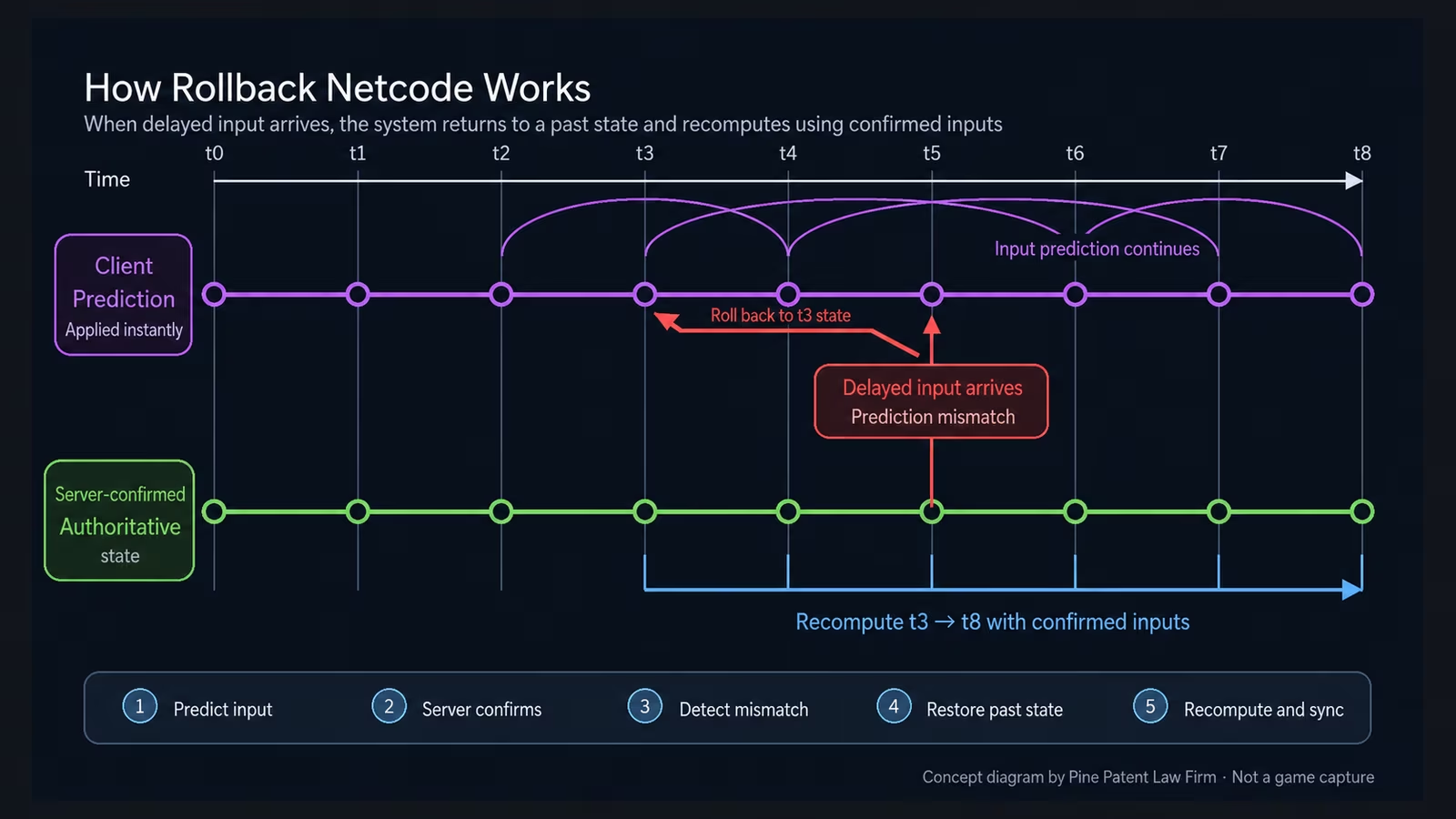
Rollback netcode is another strong patent candidate. When an opponent's input has not yet arrived, the game proceeds using a predicted input. Once the actual input is received, the system returns to a past state and recalculates the game state.
This approach can include numerous detailed inventions: how state snapshots are stored, how inputs are predicted, how frames to be recalculated are selected, how interpolation reduces screen jitter, and how exceptions are handled when computation exceeds a threshold.
Network technology is not tied to a particular genre or character and may be applied repeatedly across games. It can therefore have broader commercial value as platform technology than individual game content.
3. Camera and presentation technology
A game camera is not merely a virtual filming device that follows a character.
Camera position determines where the player looks, which direction the player moves, and which dangers are recognized first. Combined with map design, it can even guide the player's route and behavior.
Camera-control technology may use, for example:
- the character's movement direction and speed;
- the aiming or viewing direction;
- the positions of nearby enemies and key objects;
- obstacles between the camera and the character;
- the distance to the edge of the screen; and
- the player's recent control pattern.
Based on these data, the system may calculate a target camera position and rotation, apply a dead zone and interpolation function, and change the actual camera position.
What matters is not the result, “the camera moves smoothly,” but the conditions under which target values are calculated and the interpolation method used to move the camera.
When a wall or terrain blocks the camera, a method that changes the camera position or makes the obstacle translucent based on the distance between the obstacle and character, the obstacle's opacity, and the camera's permissible movement region may also be patentable.
Presentation technology may look like design when one sees only the resulting screen, but the camera calculations and object-control processes that generate that screen can be framed as a technical invention.
4. Graphics and sound technology
Normal maps, billboards, blending, procedural sky generation, wave rendering, and pixel-art processing are core elements of game graphics.
It is not advisable, however, to file an application based only on a mathematical formula or visual result. The application should explain how the formula is used in the rendering pipeline and what technical effect it creates compared with existing approaches.
For water-rendering technology, for example, the following may be specified:
- how multiple wave components are configured;
- how the number of waves is adjusted according to the distance between the camera and water surface;
- how calculations for regions not displayed on the screen are omitted;
- how a normal vector is calculated according to wave height; and
- how the mixing ratio of reflected and refracted light is determined.
If the method reduces graphics-processing computation, memory use, or frame delay while maintaining the same or similar visual quality, that technical effect can be emphasized.
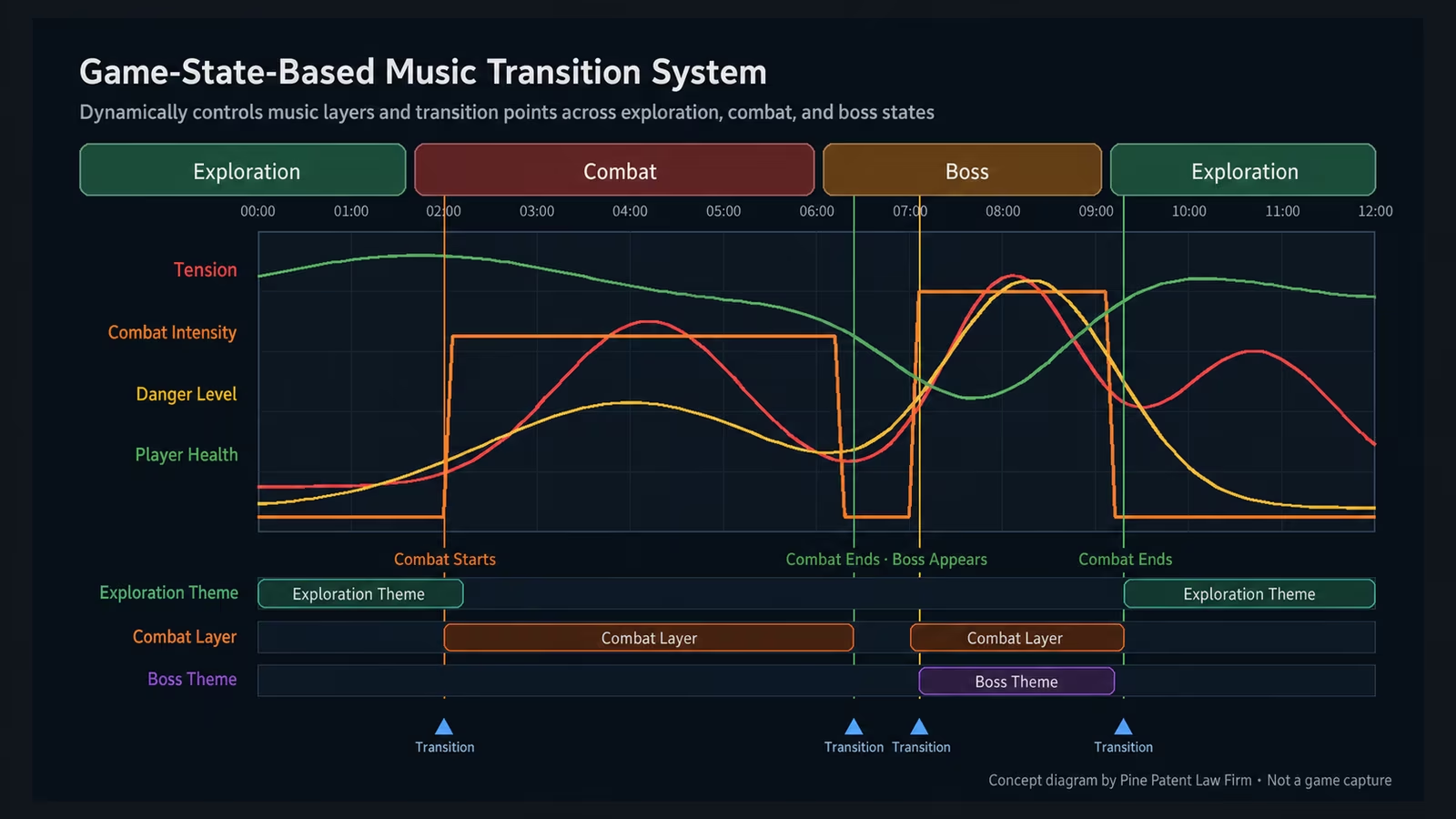
Techniques for transitioning game music may also be patentable. The system can detect a game state such as entering combat, discovering an enemy, losing health, or moving to a new boss phase, analyze the beat and measure of the current music, and determine a natural transition point.
The focus of the application should be the linkage between game-state data and music data, calculation of the transition section, and audio-output control structure—not the aesthetic quality of the music itself.
5. Procedural generation and game AI
Procedural technology that automatically generates random dungeons, terrain, item placement, and enemy placement is a representative field for game patents.
Simple random generation alone may not be sufficiently distinctive. It can, however, develop into proprietary technology when combined with constraints such as:
- a minimum travel distance between the starting point and goal;
- the number of branching routes;
- connectivity between rooms or terrain sections;
- distribution of enemies and rewards according to player difficulty;
- placement of areas that require a particular ability to pass; and
- validation of the generated result followed by regeneration of only invalid sections.
For pathfinding, merely applying Dijkstra's algorithm or the A* algorithm may also be insufficient. The technology should be distinguished by designing a game-specific cost function or reducing the search range based on character size, movement capability, risk, and the player's predicted route.
Dynamic difficulty adjustment can analyze the player's death count, input accuracy, movement speed, resources, and time spent in a stage to change enemy statistics or item placement.
The important point is not merely the goal of “making the game easier for beginners.” The application should specify what data is used to assess the player's state and how, and within what range, the assessment is reflected in game parameters.
6. Probability and matchmaking technology
Probability systems and matchmaking are not directly visible to users, but they are core technologies that determine the quality of a game service.
A pseudo-random system may adjust the probability of the next outcome by using the number of recent failures, accumulated play count, or acquisition history. Beyond simply changing a probability value, a method can maintain a target probability distribution while controlling the likelihood of consecutive failures or successes.
Matchmaking may use factors beyond a simple skill score, including:
- role or character preference;
- network latency;
- play patterns;
- party composition;
- waiting time;
- recent win-loss record; and
- predicted match quality.
Patent candidates may include gradually widening the permitted skill gap or network-latency range as waiting time increases, reducing matchmaking bias for a particular user group, or calculating expected match quality in advance.
A strong game patent expresses a function as a legal right
When filing for game technology, it is advisable not to rely on only one claim format.
Latency-compensated shooting judgment technology, for example, may be structured in the following forms.
First, a game-control method protects the sequence of steps performed by the server.
Second, a game server or game system protects functional components such as a storage unit, communication unit, and processing unit.
Third, a computer-readable recording medium storing a computer program protects a program that causes a computer to perform the method.
The Korean Intellectual Property Office also distinguishes computer-related inventions as method inventions expressed as time-sequential steps, product inventions expressed as multiple functional elements, and media on which a program is recorded.
Dependent claims tailored to game genre, input device, server architecture, and user terminal can provide multidimensional protection for one technology.
Find inventions during development, not after completion
The biggest reason game companies struggle to identify patents is that they review patent opportunities only after development is complete.
In a finished game, every function has merged into one result, so the boundaries of each invention are difficult to see. During development, by contrast, inventions become clear at moments such as:
- discovering a problem the existing engine cannot solve;
- applying a new approach to reduce frame-rate drops or network latency;
- changing judgment logic in response to play-test results;
- creating a new algorithm to implement a designer's requirements; and
- adopting a technical solution different from existing ones after repeated failures.
When identifying game technology, Pine IP Firm recommends first writing down four sentences:
What problem existed in the conventional approach?
What input data is used?
In what sequence does the computer process the data?
What performance or user experience is improved as a result?
If these four questions can be answered specifically, the technology may be developed into a patent.
File before releasing videos, development logs, or conference presentations
If development technology is first disclosed through YouTube, a blog, a developer conference, a demo day, or a game launch, the disclosed material may be used as prior art during patent examination. Under Korean patent law, an invention that was publicly known in Korea or abroad, or made available to the public over the Internet before filing, may lose novelty.
If the inventor or rights holder made the disclosure, a grace-period exception may be claimed under certain conditions within 12 months of the disclosure date. However, the relationship between the disclosed material and the filed invention must be proven, and foreign-filing strategies may be affected. It is therefore safer to treat the grace-period exception as a remedy for unavoidable cases, not as the default strategy.
Patentability should be reviewed before publishing a video or development log that introduces a new technology.
A game's differences appear in its content, but competitiveness accumulates in its technology
Players experience the finished result: a natural camera, accurate yet forgiving hit detection, seamless multiplayer, realistic water and skies, appropriate difficulty, and probability systems that feel fair.
Behind those experiences, however, lie countless formulas, algorithms, state determinations, network-processing methods, and exception-control technologies.
A game's characters, images, music, and story can be protected by copyright, trademark, and design rights. Separately, the way the game works and the technology that solves its problems should be protected by patents.
In particular, control feel, collision judgment, camera control, netcode, procedural generation, rendering optimization, and matchmaking are not functions used only in one game. They are core assets that can be reused in sequels, other genres, proprietary engines, and external licensing businesses.
Fun begins with design, but technology is what makes that fun reproducible.
Turning technology created during game development into a patent portfolio instead of leaving it as mere know-how is how a game company converts its development capabilities into a long-term business asset.