
NAVER-Affiliated Patent Records: Applicants, Jurisdictions, Status, and IPC
This analysis covers 10,695 patent-document records associated with NAVER and related applicant names. The records show sustained activity in digital data processing and business-process technologies, together with later records in image processing, robotics, communications, artificial intelligence, positioning, and control.
Dataset and normalization
The source workbook contained 10,820 rows as of July 8, 2026. It included Korean and English applicant names, historical NHN and NBP names, LINE- and Yahoo-related co-applicants, joint applications, and unrelated search results. The analysis excluded 125 clearly unrelated rows and retained 10,695 records.
“NAVER-affiliated” is a dataset label, not a conclusion about current ownership. It includes records bearing NAVER, NHN, NBP, NAVER LABS, NAVER WEBTOON, LINE- or Yahoo-related applicant forms, and related co-applicant forms found in the workbook.
| Item | Data point | Methodological significance |
|---|---|---|
| Raw records | 10,820 | All rows in the Keywert-based workbook |
| Analytical set | 10,695 | After exclusion of 125 unrelated search results |
| Year range | 1985-2026 | Application date, or earliest priority date when the application date was missing |
| Registered records | 6,894 (64.5%) | Records identified as registered in the source data |
| Average family countries | 2.44 | Median 2; maximum 19 |
The unit is a document record. The same invention may appear in more than one row when it was published or registered in multiple jurisdictions. Counts in this article therefore describe the collected records and should not be treated as counts of unique inventions or active patent families.
Records by application year
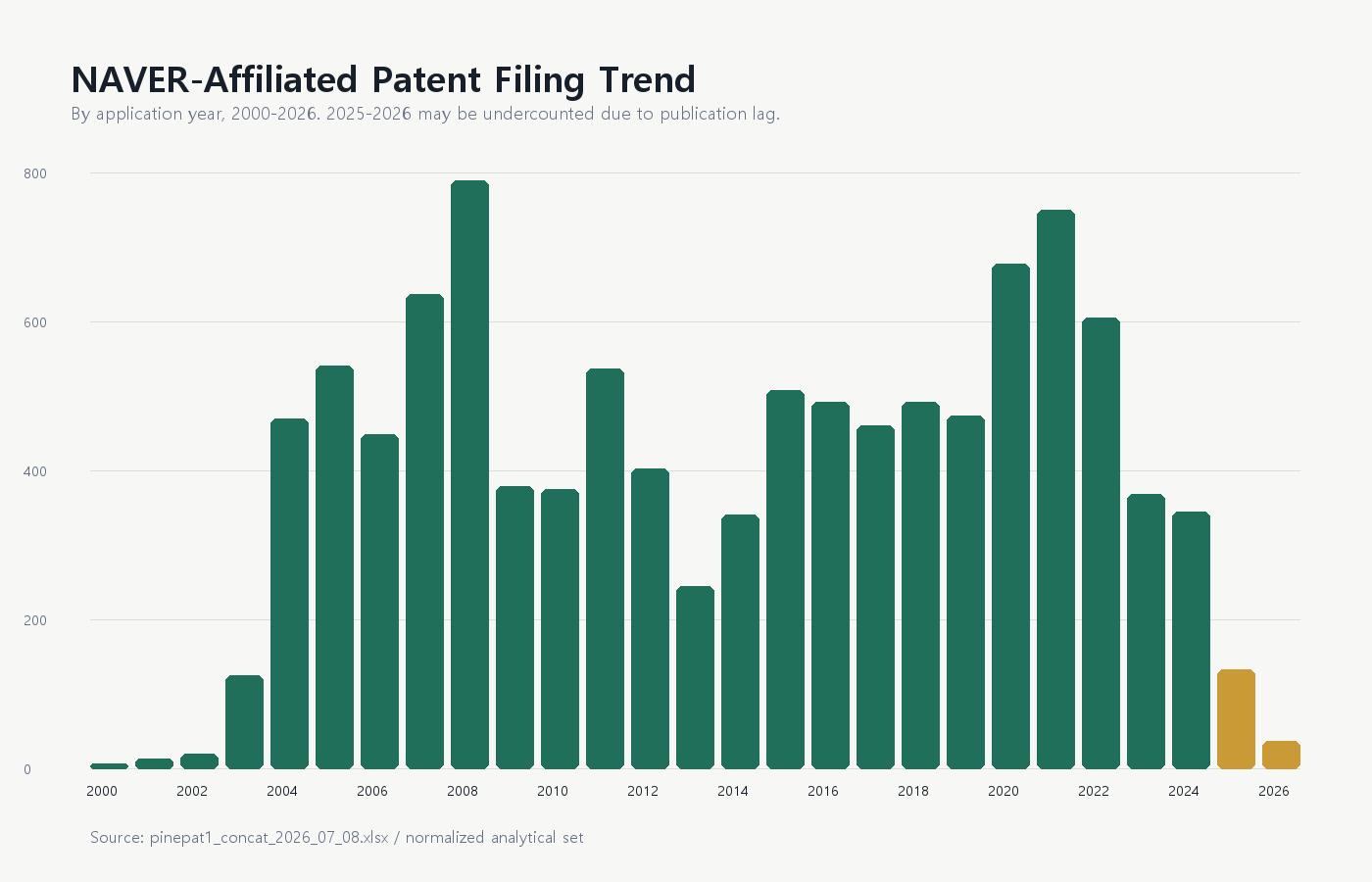
The annual count reached 790 records in 2008. Records from that period include portal search, advertising, online games, communities, and content-service technologies. After lower annual counts from 2009 through 2014, the dataset shows another sustained period of activity, including 678 records in 2020, 750 in 2021, and 606 in 2022.
The 2020-2022 records include cloud operations, recommendation and generation systems, robotics, autonomous movement, computer vision, speech processing, and network security in addition to search and platform services. These classifications and titles establish the technologies represented in the published records; they do not by themselves establish research expenditure, product revenue, or the commercial value of any patent.
Applicant groups
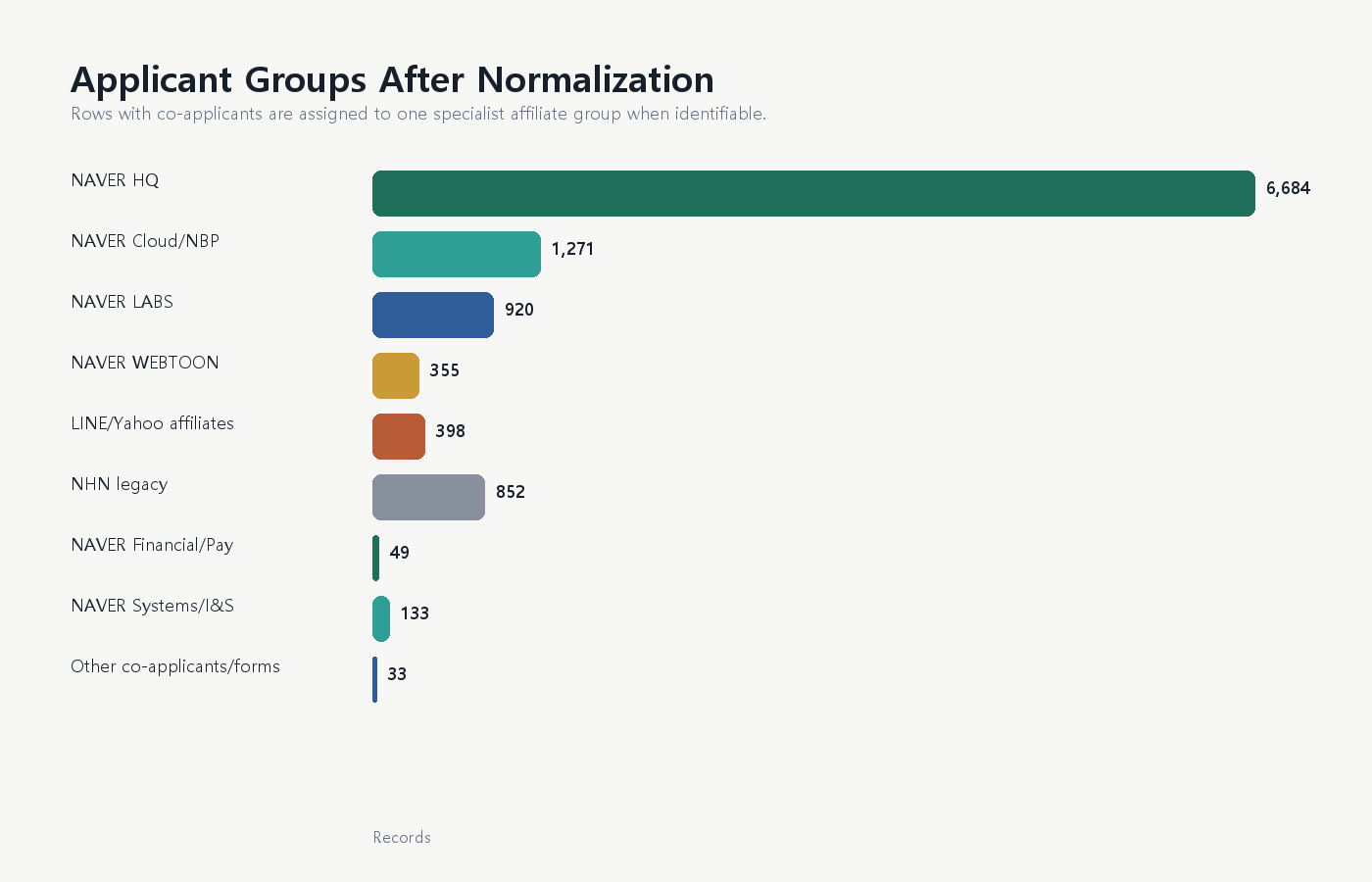
NAVER accounts for 6,684 records. The normalized groups also contain 1,271 NAVER Cloud or NBP records, 920 NAVER LABS records, 852 historical NHN records, 398 LINE- or Yahoo-related records, and 355 NAVER WEBTOON records.
The applicant groups correspond to different technical concentrations. NAVER Cloud and NBP records frequently concern infrastructure, security, distributed processing, and service operation. NAVER LABS records include robotics, autonomous movement, positioning, and sensor-based systems. NAVER WEBTOON and LINE- or Yahoo-related records include content delivery, messaging, advertising, payment, recommendation, and user-interface technologies. This grouping remains an analytical normalization and should be checked against the actual applicant and assignment record for legal work.
Jurisdictions
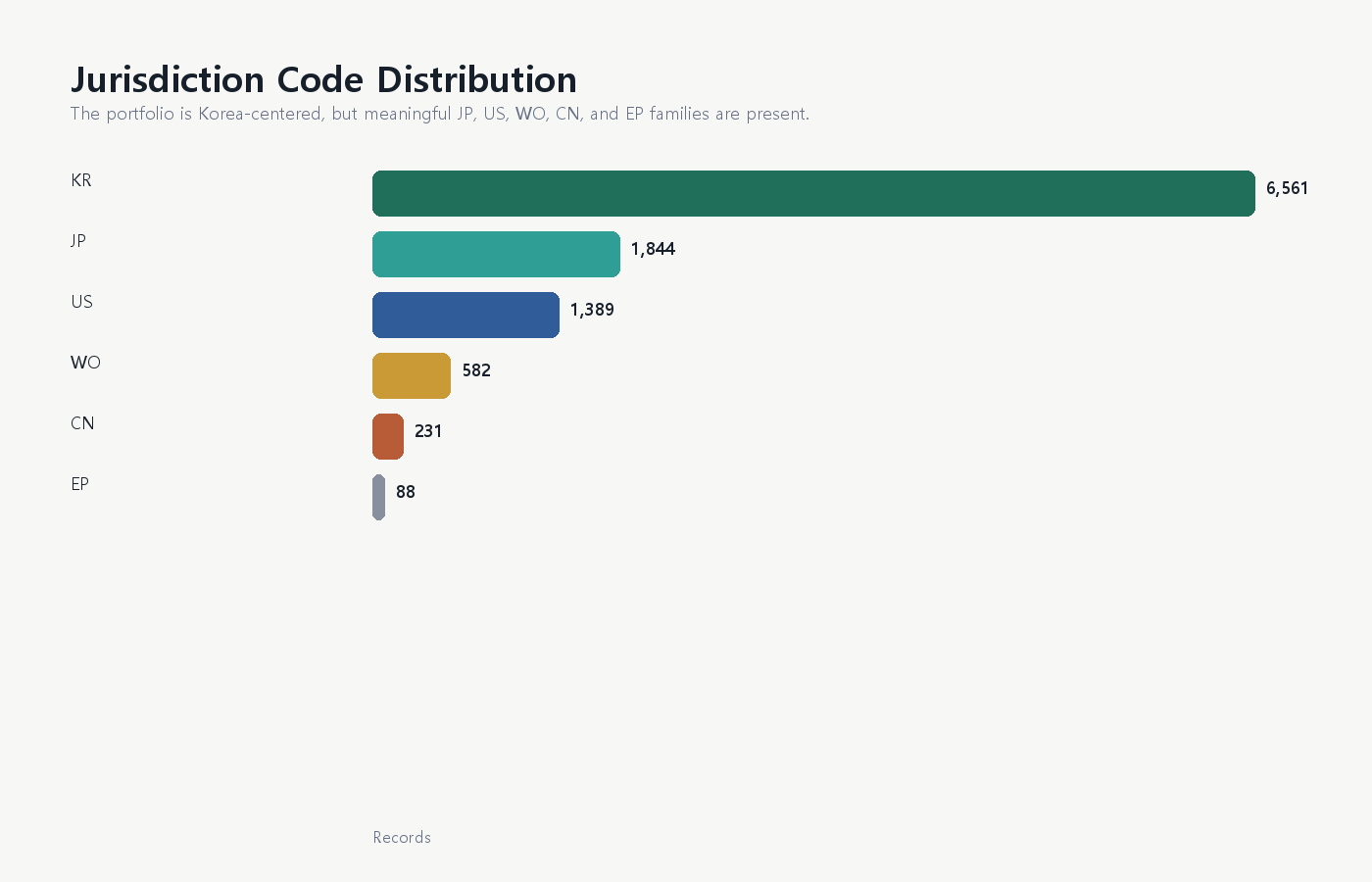
| Jurisdiction code | Records | Share |
|---|---|---|
| KR | 6,561 | 61.3% |
| JP | 1,844 | 17.2% |
| US | 1,389 | 13.0% |
| WO | 582 | 5.4% |
| CN | 231 | 2.2% |
| EP | 88 | 0.8% |
Korean records account for 61.3% of the dataset. Japan, the United States, and PCT publications account for most of the remaining records. A jurisdiction record does not establish that a corresponding right is currently in force; family relationships and current status must be verified at the application or patent level.
Legal status
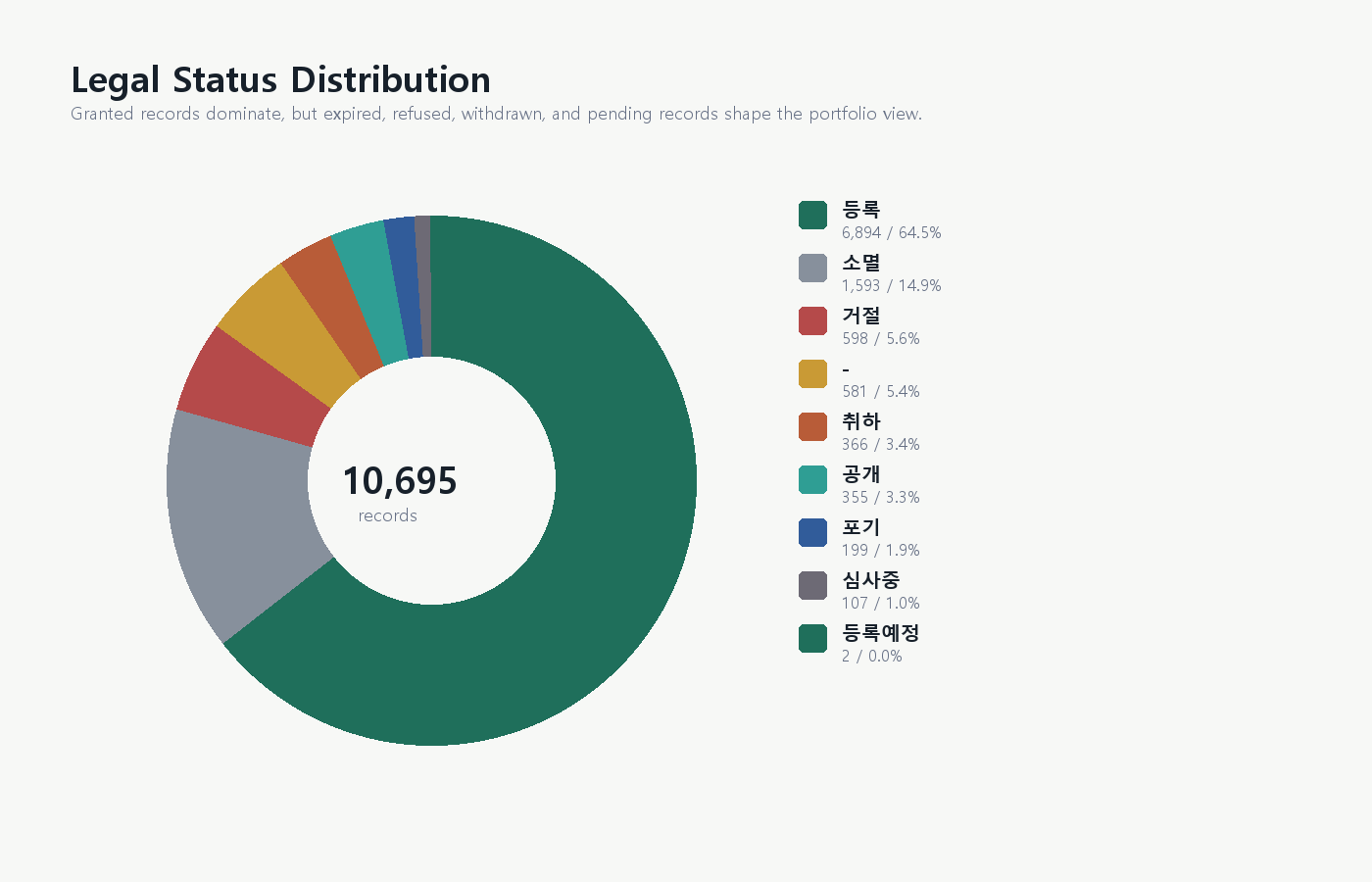
The source data identifies 6,894 registered records, representing 64.5% of the analytical set. It also identifies 1,593 expired records, 598 refused records, 366 withdrawn records, and 199 abandoned records.
These labels describe procedural status at the record level. Expiration may result from term expiry or non-payment, while refusal, withdrawal, and abandonment can arise for different legal or commercial reasons. The status data alone does not establish why a matter ended or whether another member of the patent family remains pending or in force.
G06F digital data-processing records
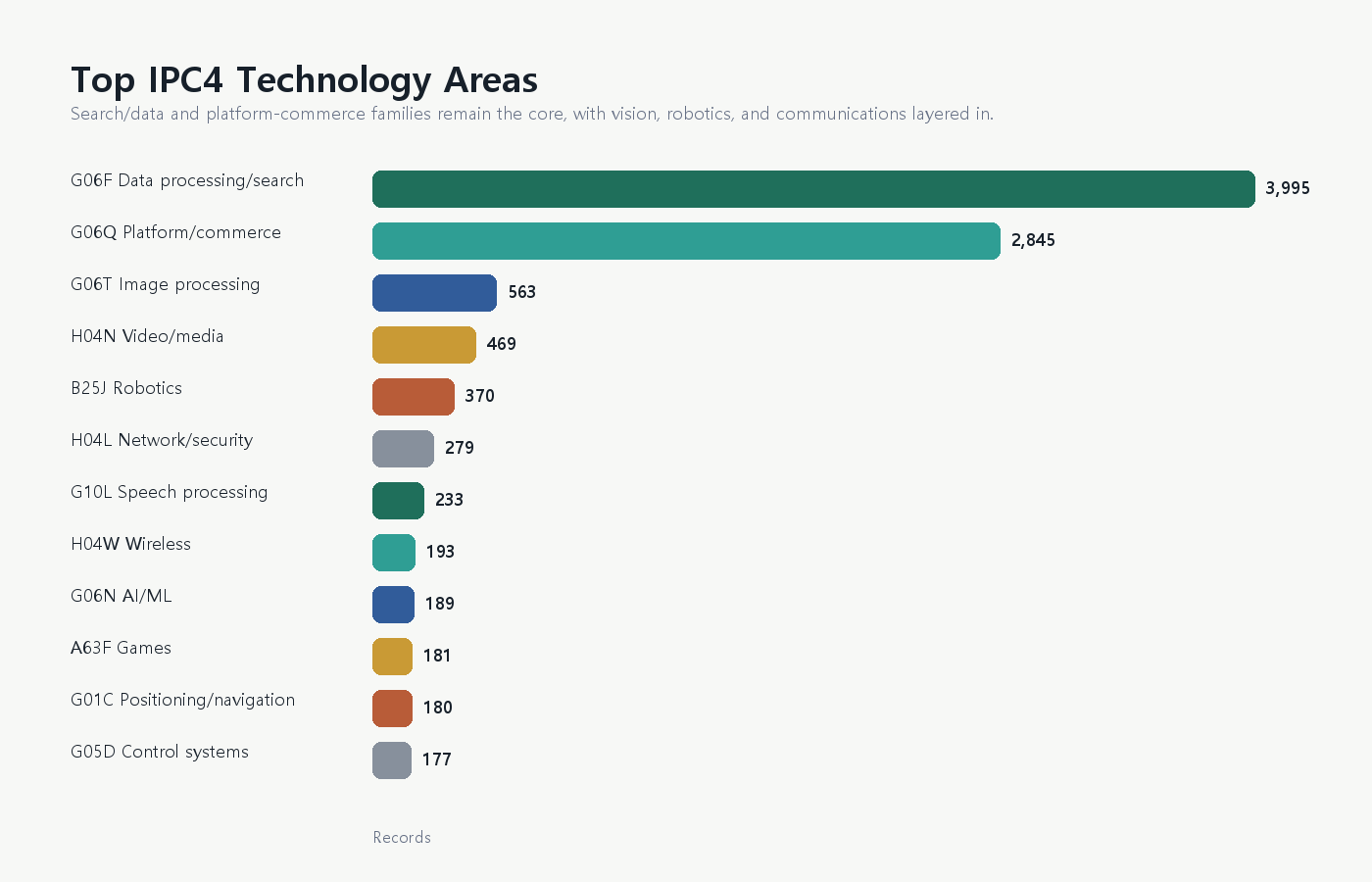
G06F is the most frequent IPC4 subclass, appearing as the main IPC in 3,995 records. Under the current IPC, G06F covers electric digital data processing. The records assigned to G06F include information retrieval, database operation, distributed processing, user interfaces, natural-language processing, software execution, and computer security.
Within the source data, 2,041 G06F records fall in the historical G06F 17 group. G06F 17/30, which covered information retrieval and database structures in earlier IPC editions, accounts for 1,319 records. Representative records concern search and retrieval, multi-device data synchronization, web-data processing, and location estimation. Other material groups include G06F 16 with 418 records for information retrieval and database structures under newer classifications, G06F 3 with 409 records for input and output arrangements and user interaction, G06F 21 with 184 records for security, and G06F 40 with 143 records for natural-language data.
The G06F counts reflect several IPC editions. A code used for an older record may have been revised or replaced in a later edition. The count is therefore useful for identifying subject matter in the dataset, but a current search should include successor codes and the claims and description of each relevant document.
G06Q business-process records
G06Q is the second most frequent IPC4 subclass, appearing as the main IPC in 2,845 records. It covers information and communication technology specially adapted for administrative, commercial, financial, managerial, or supervisory purposes.
G06Q 30 accounts for 1,555 records. These records concern commerce, marketing, advertising, product information, ordering, and related transaction processes. The largest exact-code groups in the source data include G06Q 30/00 with 613 records and G06Q 30/02 with 502 records. Representative titles address advertising delivery, product-review analysis, order intermediation, and authenticity-certificate services.
G06Q 50 accounts for 954 records and concerns ICT adapted to particular business sectors or services. Representative records address content delivery, community services, consultations, and other sector-specific service operations. The dataset also contains 157 G06Q 10 records for administration and management, 71 G06Q 20 records for payment architectures and protocols, and 38 G06Q 40 records for finance and related processes.
G06F and G06Q often describe different aspects of the same commercial system. G06F identifies the underlying data-processing, retrieval, interface, or security implementation, while G06Q identifies the administrative, commercial, financial, or service process to which the computing system is applied. Patent-scope analysis must examine the claims rather than infer scope from an IPC label.
Other technical subclasses
Other frequent IPC4 subclasses include G06T with 563 records for image-data processing, H04N with 469 records for image communication and media technologies, B25J with 370 records for manipulators and robotics, and H04L with 279 records for digital communications. The dataset also contains material records in speech processing, machine-learning models, positioning, and control.
Records from 2024 through 2026
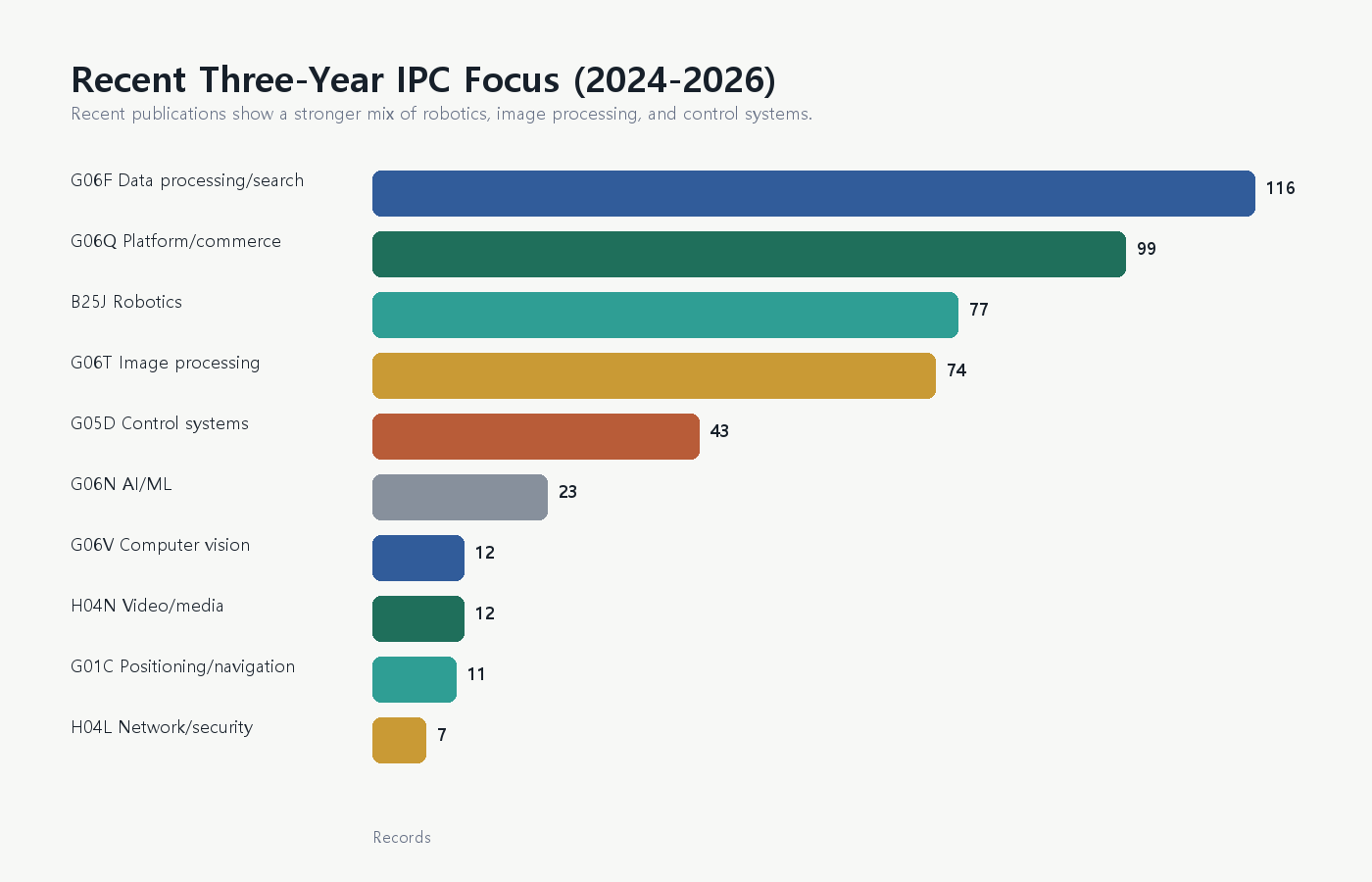
Among records dated 2024 through 2026, G06F appears in 116 records and G06Q in 99. B25J appears in 77, G06T in 74, and G05D in 43. These records cover digital data processing and business-service systems together with robot manipulators, image processing, and control of non-electric variables.
The recent counts are incomplete because many applications remain unpublished for approximately 18 months after filing. They support monitoring of robotics, vision, and control publications, but they do not support a conclusion that one technical field has displaced another or that the total filing rate has declined.
Analytical use and limitations
The dataset supports comparisons by normalized applicant name, application year, jurisdiction code, status label, and IPC classification. It does not establish current ownership, enforceable claim scope, family consolidation, or freedom to operate. Those questions require verification of bibliographic records, legal status, family relationships, assignments, and the claims of the relevant patent documents.
IPC descriptions in this analysis follow the WIPO International Patent Classification. Because the dataset spans 1985 through 2026, classification changes over time must be considered when constructing a current search.